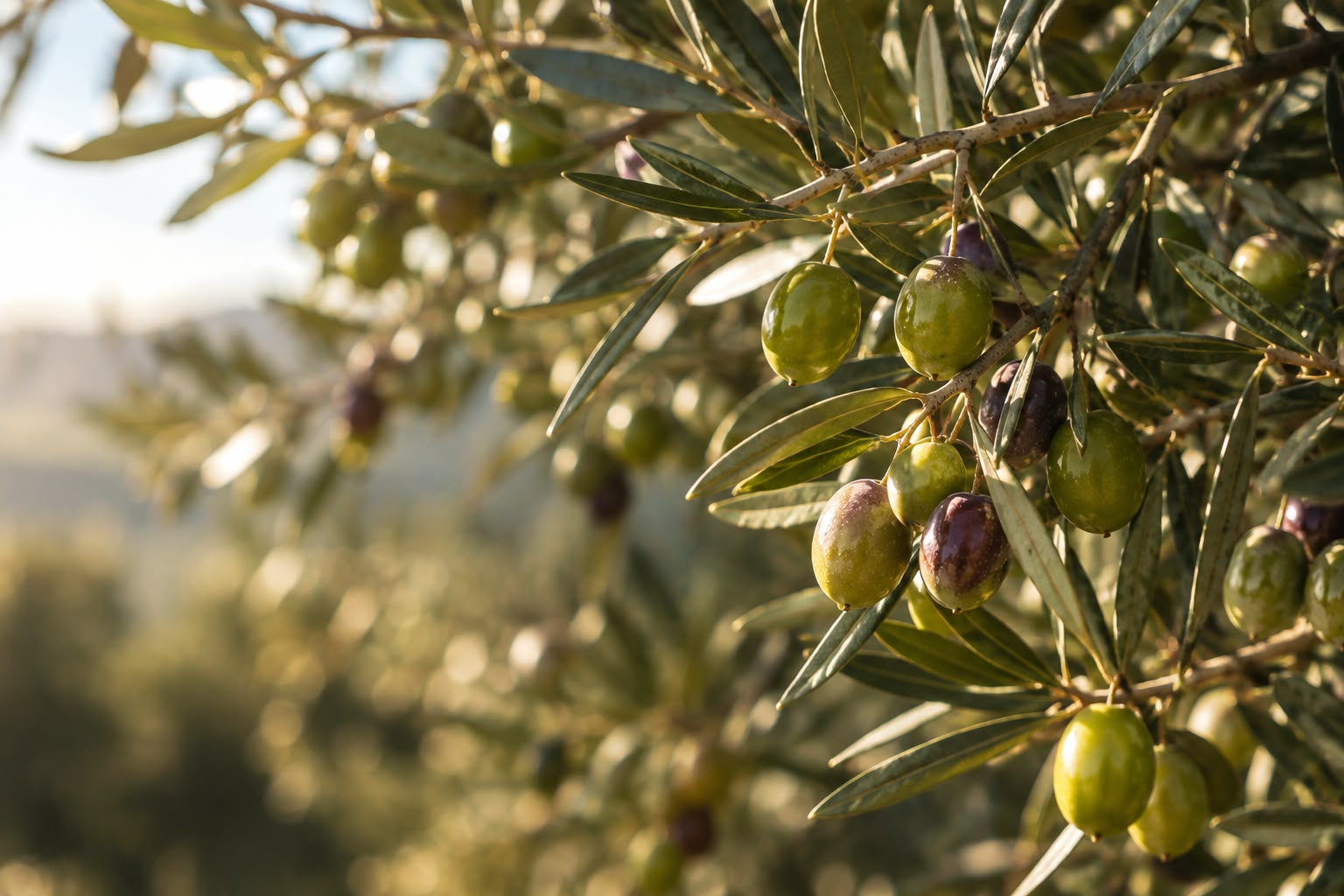
Tunisia is a small country with a big soul, blessed with fertil land and a unique Mediterranean climate. From our olive groves to the edge of the Sahara, every landscape tells a story of tradition, resilience and a deep respect for nature.
Three growing zones
The north
Cooler, wetter, with hills and a Mediterranean climate. This is Chetoui country: firmer fruit, later ripening, and oils with pronounced green bitterness and pungency.
The centre
Semi-arid plains and higher ground around Kairouan and Siliana. Oueslati is at home here, giving balanced oils with good aromatic complexity and a moderate bitter finish.
The Sahel and the south
Hot, dry, sandy and vast. Chemlali dominates — the variety that accounts for the large majority of Tunisia’s olive trees — producing softer, sweeter, lower-bitterness oils and doing so on very little water.
A climate that concentrates
Hot dry summers, mild wet winters, and long hours of sun. Rainfall ranges from around 600 mm a year in the north to under 200 mm in the south. Trees under mild water stress produce fewer, smaller olives — and a more concentrated oil. It is the same principle that makes dry-farmed vineyards interesting.
History you can still stand in
The Roman amphitheatre at El Jem was paid for by olive oil. Ancient press stones are still scattered across the Sahel. Two thousand years of continuous cultivation leaves behind more than ruins: it leaves know-how about growing olives where water is scarce.
Talk to our export desk
Ask about a specific region.
We can tell you which zones a given lot came from, and what that means for its profile.